Category: Streaming Platforms

  • Streaming Platform Business Model: The “Plateau of Personalization” is Killing Streaming Loyalty

    Streaming Platform Business Model: The “Plateau of Personalization” is Killing Streaming Loyalty

    Introduction: The Plateau of Personalization

    The streaming platform business model is reaching its breaking point. As royalties rise and loyalty declines, platforms must rethink how they create emotional value. Every major platform now offers vast content libraries, near-perfect recommendation engines, and frictionless interfaces. The race for usability is over and everyone has won.

    But with that victory comes a new challenge: sameness. When every app feels equally smooth, equally smart, and equally instant, users begin to see them as interchangeable utilities rather than meaningful experiences. The differentiation that once came from better design or smarter algorithms has quietly eroded.

    The next evolution of streaming won’t come from faster load times or sharper thumbnails. It will come from something deeper — the ability to emotionally connect. Platforms that understand not just what we click, but why we feel, will shape the next era of digital loyalty.

    And nowhere is this challenge more evident than in Netflix’s current struggle — a platform that once redefined entertainment, now facing the limits of personalization and the growing fatigue of its own success.
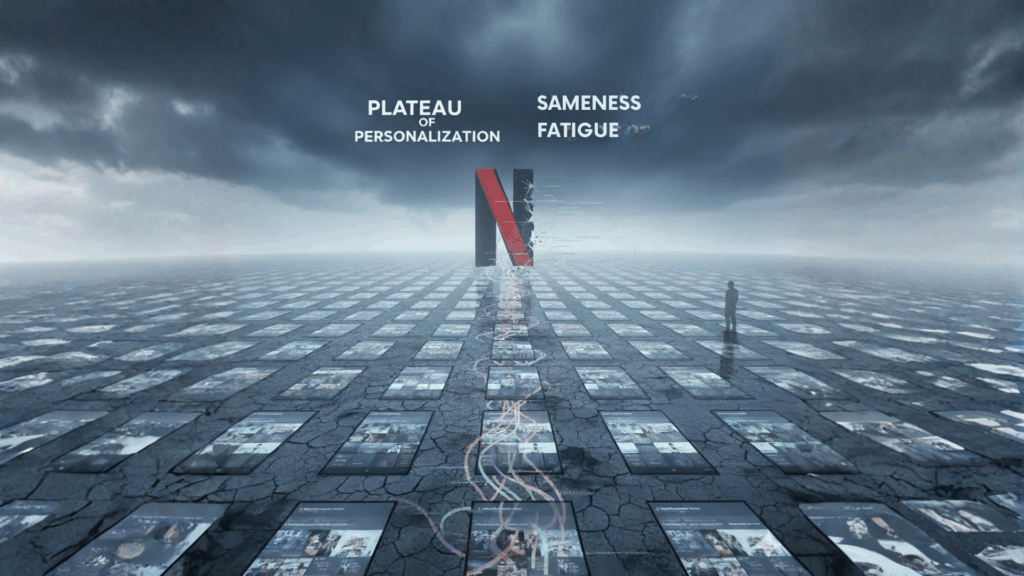
    Every app feels the same. Every recommendation is predictable. As Netflix faces the “Plateau of Personalization,” are we witnessing the limits of current streaming models?

    Redefining the Streaming Platform Business Model Through Emotion

    The economics of streaming look simple on a slide: subscribers pay a monthly fee, content attracts attention, the platform scales. In practice the math is much tougher. Netflix is spending at scale, roughly mid-teens billions on content annually and publicly signaled plans to push cash content spend toward ≈$18 billion in 2025, even as competition and subscription fatigue squeeze margins and make each incremental dollar of programming riskier.

    That pressure is not unique to Netflix. Spotify’s business model famously routes a very large share of revenue to rights holders, industry reporting places royalty and label payouts at roughly ~70% of gross revenue, which leaves only a thin margin to fund growth, product development, or dramatic new consumer experiences. The result is a cycle where platforms must invest heavily to stay relevant, while the return on that content investment is increasingly uncertain.

    At the same time consumers are showing signs of subscription fatigue. Recent market data and consumer studies report that average household streaming spend has pulled back and that sign-up velocity and willingness to add yet another subscription are weakening. In this context, price increases, password-sharing crackdowns and ad tiers can spike sign-ups in the short term but they don’t resolve the underlying question of why customers should stay if the emotional bond isn’t there.

    The practical consequence for business metrics is stark: retention and lifetime value (LTV) have become fragile levers. Platforms can win short bursts of growth (as Netflix did when it limited password sharing), but durable economics require that paying customers feel something deeper than utility. Empirical studies on brand emotion show massive returns to emotional connection — customers who feel emotionally connected to a brand deliver far higher LTV and advocacy than those who are merely satisfied, and that premium matters when content costs run in the tens of billions.

    Put bluntly: the current model optimizes for behavior (clicks, watch time, short-term retention) while leaving the emotional substrate of value creation under-designed. With content budgets ballooning and consumer attention fragmenting, streaming leaders need a new, defensible layer that converts expensive content spend into lasting memory and trust rather than one-off viewing spikes.

    The Rise of Emotional OS

    When every platform looks the same, differentiation can no longer come from what you stream, it has to come from how it feels. Behavioral personalization, the algorithmic model that recommends “more of what you liked,” has reached its natural ceiling. It reads patterns, not people. It predicts clicks, not consciousness. Streaming platforms have mastered behavioral optimization, but they’ve never learned to design for the human state.

    This is where Emotional AI enters the stage. Instead of tracking surface-level behavior, it decodes deeper signals of emotional state, memory formation, and trust calibration. This evolution is not about manipulation; it’s about resonance. When systems understand how users feel, not just what they do, the experience becomes adaptive, alive, and reciprocal.

    RARI’s Emotional OS embodies this shift. It isn’t another layer of recommendation logic; it’s an underlying framework that synchronizes content delivery with human emotion. By translating neural and emotional signals into real-time personalization, it transforms streaming from a transactional process into a living dialogue between technology and the mind. Where today’s systems deliver content, Emotional OS delivers connection.

    That transformation changes everything. Emotional OS moves personalization beyond utility from “this suits your taste” to resonance: “this meets your mind where it is.” It bridges cognition and feeling, turning data into empathy. In a market overflowing with similar content, that empathy becomes the rarest and most defensible advantage. You can replicate a catalog, but you cannot replicate a connection.

    For streaming leaders, this isn’t science fiction. It’s the foundation of a new competitive architecture where technology evolves from serving the user to sensing them.
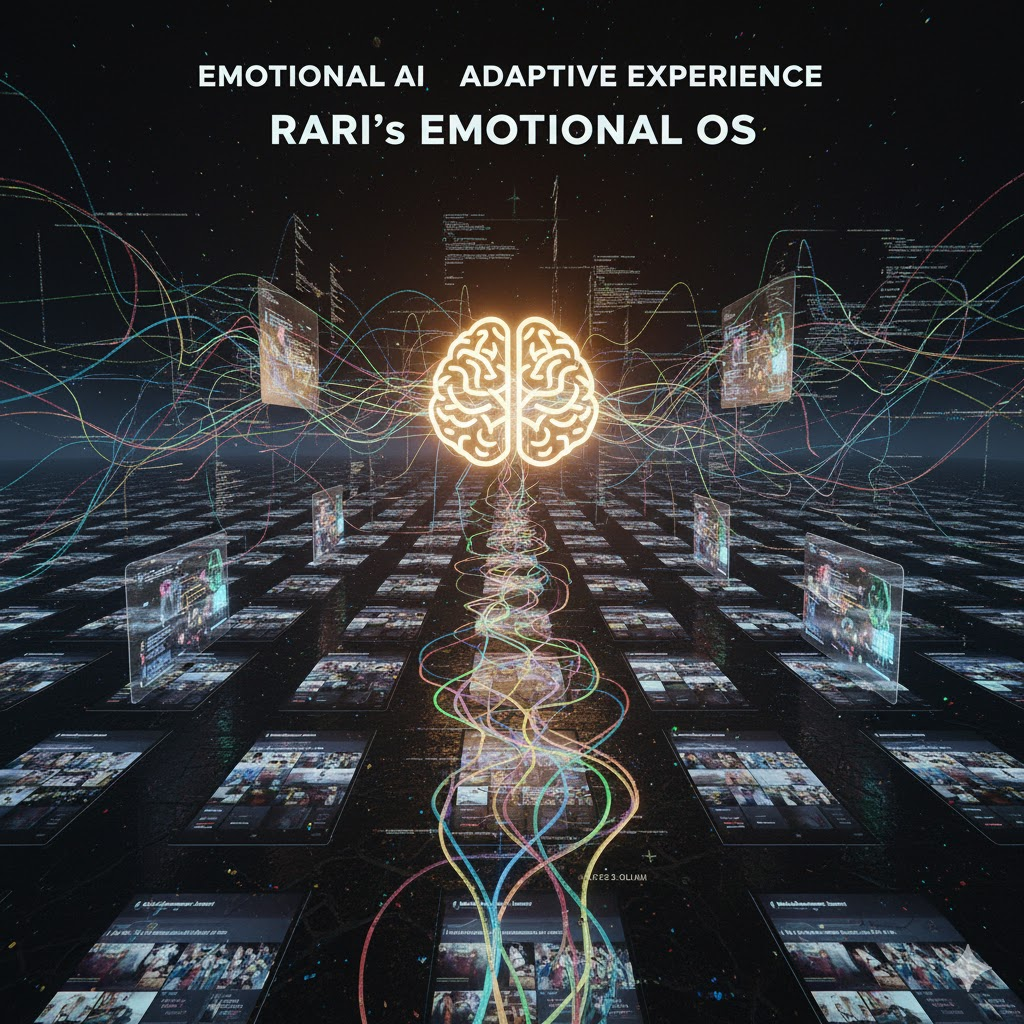
    Moving beyond behavioral data. Emotional AI is here to bridge cognition and feeling, making every streaming session a living, adaptive experience. This is the future of digital connection.

    Redefining the Streaming Platform Business Model Through Emotion

    RARI reimagines what it means to connect with an audience. Instead of treating personalization as a data problem, it treats it as a human one. Every click, pause, or skip is not just an interaction—it’s a reflection of an underlying state. RARI’s AI-Guided Neural Personalization goes beyond behavioral data and builds from the inside out, aligning each experience with the listener’s unique emotional and neural patterns. It learns not only what people like, but how their minds respond, adapt, and evolve in real time.

    At the heart of this system lies Soundprint, an emotional fingerprint that captures the subtle ways each brain reacts to sound. Two people may listen to the same song, but their neural responses can differ entirely. Soundprint translates those responses into adaptive sonic experiences—music, tones, and frequencies that subconsciously synchronize with the user’s current state. The result isn’t just engagement; it’s resonance. It feels natural, personal, and deeply human.

    But the real magic happens over time. RARI integrates a Memory and Trust Layer—a cognitive infrastructure that strengthens with every interaction. Each session becomes a building block of familiarity and emotional continuity. Instead of chasing short-term engagement spikes, the platform compounds long-term loyalty and brand equity. Users begin to associate the platform not just with content they consume, but with how it makes them feel.

    This is how RARI redefines streaming. It transforms platforms from reactive distributors into proactive companions—systems that understand, remember, and adapt to human emotion. It’s personalization not as prediction, but as partnership.

    Business Impact for Streaming Platforms

    When streaming platforms operate purely on functional personalization, growth comes at a cost. Every new user requires marketing spend, and every retained one depends on an endless stream of fresh content. RARI’s Emotional OS changes that equation by introducing an entirely new dimension of value: emotional retention.

    By aligning experiences with the user’s internal state, platforms reduce churn not through gimmicks or content volume, but through resonance. Emotional familiarity builds trust; trust builds loyalty. Over time, this translates directly into stronger retention and a higher lifetime value (LTV) per user because people don’t just stay where they find content; they stay where they feel understood.

    This emotional bond also opens a path to monetization beyond utility. When a streaming platform evolves into a companion that adapts to a user’s mood or focus, it unlocks new categories of value from wellness-driven listening modes to cognitive enhancement soundscapes and personalized brand experiences. These emotional ecosystems don’t just add revenue streams; they expand what a streaming service is and means to its audience.

    And in a market crowded with lookalikes, RARI gives streaming leaders a strategic edge that competitors can’t replicate. Algorithms can be copied. Catalogs can be licensed. Interfaces can be cloned. But an adaptive emotional relationship built over time through neural-level personalization is a moat that no amount of capital can breach.

    In short, Emotional OS transforms streaming from a utility model into a relationship economy. It’s not about who has the most songs, but who creates the most meaningful moments.
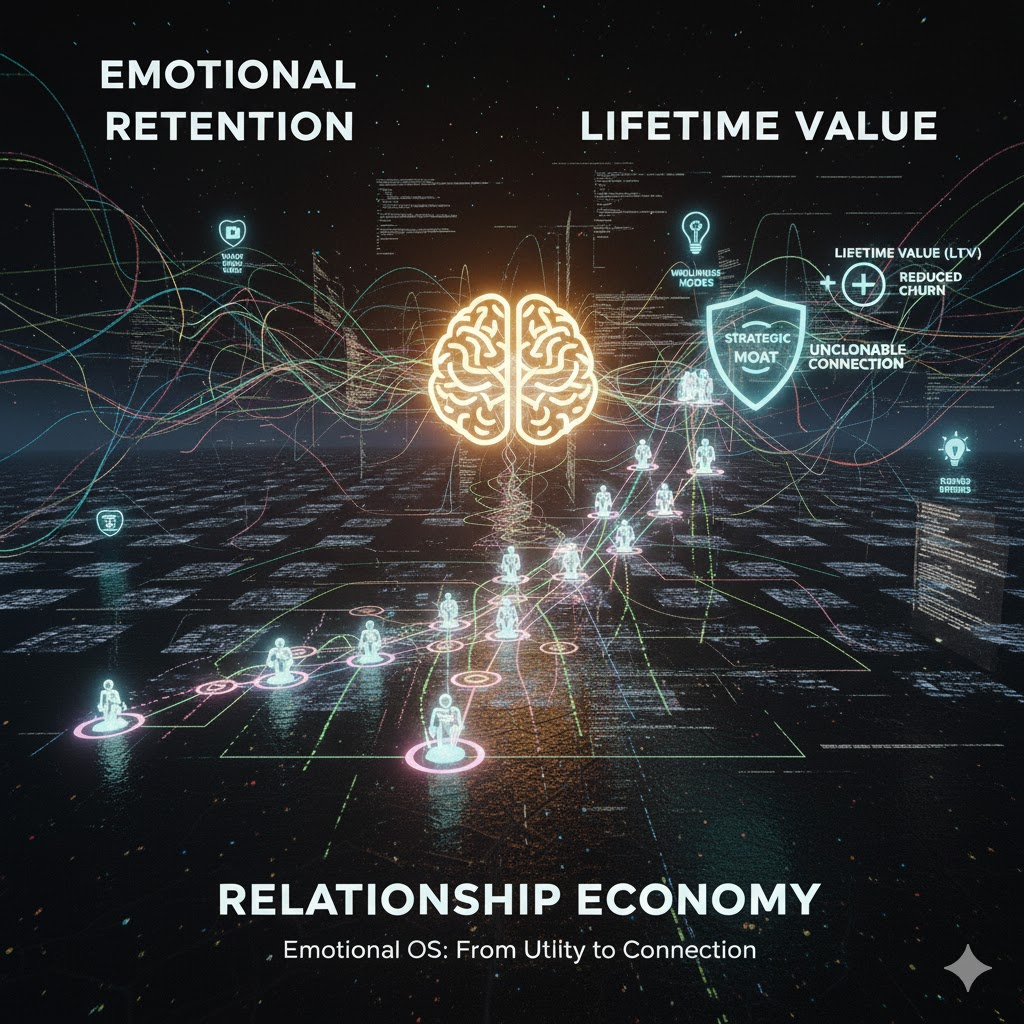
    Beyond utility, into loyalty. RARI’s Emotional OS drives Emotional Retention and boosts Lifetime Value by transforming streaming into a true Relationship Economy.

    Conclusion

    The next frontier of streaming won’t be won by whoever has the biggest catalog or the slickest interface. It will be led by those who understand that human attention is not a metric, it’s an emotion. The platforms that learn to design for feeling, not just for function, will command a different kind of loyalty: one that can’t be bought with discounts or acquired with ads.

    RARI’s Emotional OS represents this shift in motion. It turns passive listening into emotional dialogue, transforming streaming from a transactional service into a trusted companion that adapts, remembers, and evolves with each user.

    As the streaming economy matures, survival will belong to those who build relationships, not just libraries. The question for today’s leaders isn’t how to optimize engagement, but how to create resonance.

    Because in the next era of loyalty, the winners won’t be the platforms that know the most about what people do but the ones that understand how they feel.

    If this idea resonates with you, take the next step. We’ve distilled the science, psychology, and system design behind Emotional OS into a whitepaper built for streaming leaders who are ready to reimagine connection at scale.

    👉 Download the RARI Whitepaper and see how Emotional AI, Sound Print, and Neural Personalization are reshaping the future of streaming.

    Not as a trend. But as the next operating system for human experience.
  • Why Streaming Platforms Are Losing Loyalty & How To Solve

    Why Streaming Platforms Are Losing Loyalty & How To Solve

    Introduction

    Over the past decade, streaming platforms have perfected the art of usability. Every pixel, animation, and swipe has been tuned for efficiency. Users can find, play, and skip with almost no friction. The interfaces are clean. The experiences are instant. And the design teams have done what they set out to do, make content delivery effortless. But there’s an uncomfortable paradox in that success:

    As the experience becomes smoother, it also becomes emptier.

    People aren’t leaving because of bad interfaces. They’re leaving because nothing feels worth staying for.

    In the relentless pursuit of optimization, streaming giants have built platforms that function flawlessly but feel interchangeable. The difference between one app and another is no longer emotional, it’s merely logistical. Faster loading times, smarter recommendations, cleaner layouts. Each improvement makes the system more efficient, but not more memorable. Each optimization brings us closer to utility, and further from connection.

    The data reflects it clearly. Even as engagement metrics rise, loyalty continues to decline. Subscriptions are cancelled, users rotate between platforms, and no amount of new content can permanently anchor them. Behind every churn percentage is a psychological truth: human attention doesn’t attach to speed, it attaches to meaning.

    The business consequence is severe. When users aren’t emotionally invested, they act rationally: comparing prices, switching plans, chasing promotions. Emotional differentiation, once the invisible moat of great entertainment brands, has eroded into algorithmic sameness.

    This is the silent crisis of the streaming economy:

    Platforms have maximized usability at the cost of memorability. They’ve optimized everything users touch, but not what touches users back.

    And that raises a more existential question for the decade ahead:

    When utility has been perfected, what’s left to compete on?

    Why UI/UX Optimization Isn’t Enough

    Streaming platforms have spent years perfecting speed, navigation, and recommendations. These changes boost initial engagement. But recent studies show that satisfaction with UX alone doesn’t guarantee long-term retention or loyalty.

    A 2025 study in Frontiers in Psychology examined factors influencing user satisfaction and continuation intention in music streaming. The study found that while system quality and ease of use drive satisfaction, long-term retention depends far more on service quality and emotional connection than on sleek interfaces.

    Another paper, “Determinants of User Retention in Streaming Services: The Role of Content Library and User Experience,” surveyed nearly 500 streaming service users. It revealed that while a large content library and good UX are necessary, they only drive retention when combined with perceived uniqueness and relevance of content. If your service feels like “just another option,” it becomes trivial for users to switch.

    Hence, when every global streaming platform matches in interface polish and recommendation speed, those are no longer sources of differentiation. They become hygiene factors — essential to compete on, but not enough to build attachment. In such an environment, emotional resonance (why the experience feels meaningful) becomes the variable that separates average churn from sustainable loyalty.

    The Financial Trap

    Behind the polished interfaces and billion-dollar recommendation engines lies a brutal economic reality: most streaming platforms are structurally unprofitable. Their growth may look impressive on the surface: millions of new users, soaring play counts, global reach… but underneath the numbers, margins are collapsing. The business model that once revolutionized access to content has now trapped itself in an endless cycle of scale without sustainability.

    At the heart of this trap is the royalty system. On average, nearly **70% of streaming revenue flows directly to content rights holders:** labels, publishers, and distributors. That leaves barely a third to cover everything else: platform operations, infrastructure, marketing, innovation, and profit. In practice, it means that for every dollar earned, only a few cents remain to fund differentiation. The result is predictable: the bigger the catalog, the thinner the margin.

    This structure creates a paradox of growth:

    The more successful a platform becomes, the more users it attracts, the more streams it serves, the more it owes in royalties.

    This cost structure forces platforms into one of two paths: invest heavily in content (which increases royalty payments) or lower costs elsewhere, neither of which solves the loyalty problem. Original content is expensive to produce; exclusive licensing drives up costs. A recent theoretical model in MDPI shows that platforms providing more original content see higher subscriber uptake but risk falling into expensive licensing agreements with advertisers or having to subsidize content heavily.

    Meanwhile, global music streaming revenues in 2022 generated 67% of recorded music revenue worldwide, yet premium subscriptions only accounted for ~48.3% of that share; the rest came from ad-supported tiers and other sources, indicating a lean margin on many users.

    The financial trap is therefore double-edged: platforms pay high royalties, compete on content size, AND fight to keep churn low in environments where emotional loyalty is weak.

    Without breaking this cycle, for example, by creating offerings that reduce the dependency on content licensing costs, or by building emotional attachment that increases lifetime value, many platforms risk being stuck in the low-margin + high-churn loop.

    The Neuroscience of Sound & Memory

    After years of chasing efficiency, the streaming industry has reached a paradox. Platforms have become faster, smarter, and more intuitive than ever, yet user loyalty continues to decline. The issue is no longer one of performance — it is one of connection. In the pursuit of frictionless experiences, platforms have stripped away the very thing that makes human engagement last: emotion. To understand why, we need to look beyond interfaces and into the brain itself.

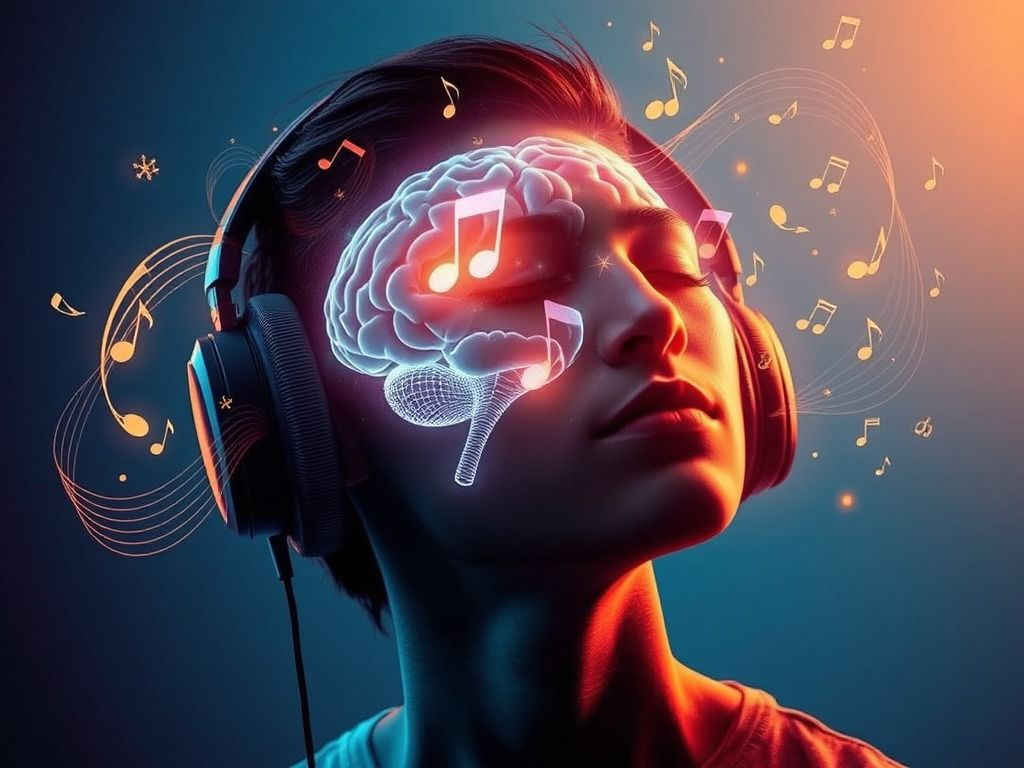
    Neuroscience reveals that emotion and memory are not abstract experiences; they are biological processes deeply tied to sound. While visuals dominate most digital strategies, the human brain prioritizes auditory input when forming and retrieving memories. This happens because sound reaches the limbic system (the brain’s emotional and memory center) before visual information is even processed by the cortex. In practical terms, this means that sound bypasses rational filtering and goes straight to feeling. A familiar melody, a specific tone, even a subtle auditory cue can instantly transport a person back to a specific place, moment, or emotional state.

    Studies have consistently validated this phenomenon. Research published in Frontiers in Psychology found that emotionally charged music triggered involuntary memories with greater clarity and emotional depth than visual stimuli. Another study in Scientific Reports (2023) confirmed that music-evoked memories were not only more vivid but also more personally meaningful and long-lasting compared to other sensory triggers. Neuroscientists describe this as auditory encoding bias — the brain’s natural preference to store and retrieve experiences linked to sound. These findings highlight a simple but profound truth: humans do not just hear sound; they feel it, store it, and relive it.

    From Emotion to Connection — The Business Implication

    This emotional encoding explains why a song can bring someone to tears decades later, while a photograph of the same moment might leave them unmoved. Sound reconstructs the emotional context of memory: the atmosphere, the tension, the joy, the nostalgia. It recreates the feeling, not just the image. From a business perspective, this insight changes everything. If sound has the power to reactivate emotional memory, then it also has the power to shape brand attachment. Loyalty, after all, is not built through convenience or interface design; it is built through repeated emotional recognition.

    Streaming platforms are uniquely positioned to harness this dynamic. Unlike social media or visual-based platforms, their core medium — sound — already speaks the brain’s emotional language. Yet most continue to treat it as content, not connection. Algorithms still focus on predicting behavior rather than evoking meaning. Personalization engines recommend “what you might like” but rarely capture why you love it. This is where the opportunity lies: by designing experiences that intentionally trigger emotional recall through sound, platforms can create durable, identity-level attachment.

    In that sense, the future of streaming is not about who owns the most content, but about who owns the most meaning. The platform that learns to embed emotion into sound, and sound into memory will hold something far more valuable than attention: enduring connection.

    The Future of Streaming: Competing on Emotional Connection

    By the end of this decade, content volume will no longer be a competitive advantage. Every major platform will host millions of tracks, films, and podcasts, all delivered through near-identical recommendation systems. The barriers to entry that once defined leadership: catalog size, exclusive rights, algorithmic precision… are dissolving under the weight of technological parity. When everyone can deliver infinite content, the differentiator will no longer be what users can access, but how those experiences make them feel.

    In this new landscape, emotional connection becomes the most defensible business moat. Platforms that master the psychology of sound and memory will build relationships that can’t be replicated through licensing deals or interface design. Neuroscience has already shown that emotional engagement drives stronger memory formation and higher value perception — the same mechanisms that underlie brand loyalty in every other industry. In streaming, this translates directly into reduced churn, increased lifetime value, and a shift from transactional engagement to emotional retention.

    The emerging concept of the Emotional OS captures this transformation. It reimagines the streaming platform not as a distribution engine but as a living, adaptive emotional interface that learns the listener’s subconscious patterns and responds in real time to their cognitive and emotional states. Instead of optimizing playlists for consumption, it curates experiences for resonance. Instead of predicting preference, it personalizes connection.

    For the first time, technology and emotion are converging into a single strategic layer where business growth aligns with human experience. Integrating an Emotional OS doesn’t just enhance user satisfaction; it redefines the economics of retention. Each emotionally resonant interaction becomes a micro-moment of loyalty. Each personalized soundprint becomes an anchor point of identity. Over time, these accumulated emotional moments form an invisible moat around the brand that no discount or exclusive deal can replicate.

    The platforms that act first will shape the industry’s next decade. Just as data-driven personalization defined the 2010s, emotion-driven resonance will define the 2030s. Those who invest early in emotional infrastructure — decoding how sound builds meaning, will set the new standard for what a “streaming experience” means. The future of entertainment will not belong to the platforms with the biggest catalogs, but to those capable of creating the deepest human connection.

    Conclusion

    The streaming industry was built on the promise of access: unlimited content, anytime, anywhere. But in fulfilling that promise, it has stripped away the mystery, intimacy, and emotion that once made music and storytelling feel sacred. The platforms that once revolutionized discovery have become utilities: efficient, indispensable, but emotionally hollow.

    The next frontier is not technological, but emotional. The Emotional OS represents a shift from utility to humanity, from serving content to nurturing connection. It transforms streaming platforms into ecosystems that mirror the way people actually experience sound: as memory, as emotion, as meaning.

    Those who embrace this shift will not only survive the commoditization of content but transcend it. They will redefine loyalty from a metric into a feeling. They will turn engagement into attachment, and consumption into memory.

    The winners of the next era won’t be those who own the most content, but those who make users feel something unforgettable.

    To explore deeper insights, research, and case studies on how emotion reshapes engagement at RARI Emotional OS → https://www.rari.one/